
Hand Hygiene Infection Prevention and Control (IPC) Clinical Guideline
Download document
PDF 372 KB
The Hand Hygiene Clinical Guideline summarises best practice for healthcare workers in the clinical setting.


Hands are one of the main pathways for infectious agents (germs) to transmit within healthcare and the community. Good hand hygiene practices are one of the most effective measures to minimise the risk of the spread of infections.
There are around 165,000 healthcare associated infections nationally each year, making this a significant healthcare complication affecting patients in hospital.
Hand hygiene can reduce the rate of healthcare associated infection and hospital-acquired complications (HACS).
As per the SA Health Infection Prevention and Control and Healthcare Associated Infection (HAI) Surveillance and Reporting Policy and mandatory Australian Commission on Safety and Quality in Health Care (ACSQHC) National Safety and Quality Health Service (NSQHS) Standards, health service organisations are required to have a hand hygiene program consistent with the National Hand Hygiene Initiative (NHHI). Also refer to the SA Health Hand Hygiene Infection Prevention and Control (IPC) Clinical Guideline.
Health services accredited to the NSQHS Standards are required to collect hand hygiene compliance data for national audits, unless the collection of that data is not recommended for the particular setting (see National Hand Hygiene — Audit Requirements) or the service is exempted by the state and territory health regulator.
Resources to support hand hygiene programs are available via the National Hand Hygiene Initiative (NHHI), SA Health Infection prevention and control (IPC) education page and Resources section below.
The Australian Commission on Safety and Quality in Health Care (ACSQHC) established the National Hand Hygiene Initiative (NHHI) in 2008 with the aim of promoting hand hygiene and minimising the risk of infection in Australian healthcare settings.
Refer to the NHHI website for further information.
Key components of the NHHI includes auditing and reporting of hand hygiene compliance according to the WHO '5 moments for hand hygiene'. Hospitals participating in the NHHI are required to submit hand hygiene data according to the NHHI schedule.
Hand hygiene compliance is monitored via the SA Health Performance framework and key performance indicators.
As per the ACSQHC NSQHS Standards, each hospital or Local Health Network (LHN) should have had a Hand Hygiene Program Coordinator who is responsible for the governance and oversight of local hand hygiene programs.
For queries related to the NHHI, refer to the ACSQHC NHHI website or contact your LHN Hand Hygiene Program Coordinator:
Hand hygiene compliance is assessed against a national benchmark agreed to by all states, territories and the Commonwealth. The state and national benchmark is 80%. The latest hand hygiene audit data and previous reports can be viewed via the National Hand Hygiene Audit Dashboard.
The Australian Institute of Health and Welfare reports hand hygiene compliance for each audit period for public hospitals at national, and individual hospital levels, as well as by hand hygiene moment and healthcare worker group. SA Health identifies hand hygiene as a performance framework and key performance indicator.
For information regarding the use and selection of alcohol-based hand rubs, refer to the ACSQHC's Australian Guidelines for the Prevention and Control of Infection in Health Care.
The following resources have general information on hand hygiene, the appropriate use of gloves in healthcare and how to support environmentally sustainable infection prevention and control practices:
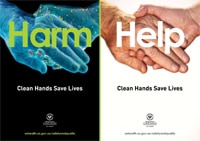
Click on the below images to download the relevant poster.
The ACSQHC has a range of promotional materials to support the improvement of hand hygiene in Australia.
World Hand Hygiene Day on 5 May is part of a major global effort led by the World Health Organization (WHO) and supported by SA Health annually. This day aims to support health-care workers to improve hand hygiene in healthcare and accordingly support the prevention of life-threatening healthcare associated infection (HAI).
Information on the latest campaign can be found on the WHO hand hygiene and ACSQHC World Hand Hygiene Day webpages.
For further information on hand hygiene contact SA Health Infection Control Service on (08) 7425 7161.