

Main Navigation
Voluntary assisted dying statistics (Voluntary Assisted Dying Review Board Annual Report 2024-25)
Under section 124 of the Act, the Review Board collects and reports on voluntary assisted dying statistics in South Australia.
Data is collected through the submission of forms and information to the Voluntary Assisted Dying Clinical Portal by medical practitioners, pharmacists, care navigators, liaisons and the Review Board secretariat at each stage of the 11-step voluntary assisted dying pathway:
- Make a first request for voluntary assisted dying
- Doctor completes a first assessment
- A consulting doctor completes a second assessment
- Complete a written declaration to access voluntary assisted dying
- Make a final request for voluntary assisted dying
- Choose a contact person
- Doctor completes a final review
- Doctor prescribes substance once permit approved
- Arrange supply of substance with pharmacist
- Decide to administer substance
- Death certification
1. Make a first request for voluntary assisted dying
First requests
The first step in the voluntary assisted dying pathway is to make a first request to a medical practitioner.
Between 1 July 2024 and 30 June 2025, a total of 579 people made a valid first request for voluntary assisted dying. Of these, 574 (99%) people had their first request accepted by an eligible medical practitioner. Figure 3 below shows an upward trend in first requests over the past 2 years from an average of 34 per month in 2023-24 up to 48 first requests per month in 2024-25.
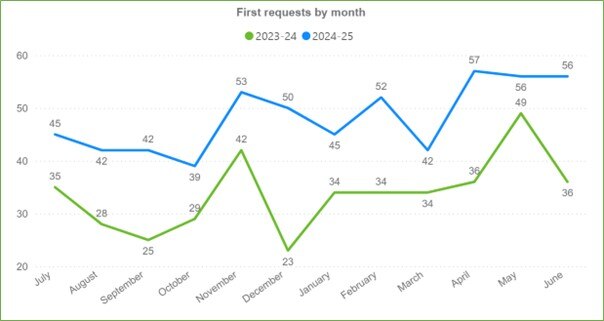
Figure 3 — First requests by month
Very few first requests are refused in South Australia. A medical practitioner is not required to provide a reason for declining a first request and such a refusal does not relate to the person’s eligibility for voluntary assisted dying.
Reasons for a practitioner refusing a first request can include the practitioner:
- not meeting the minimum requirements to act as a voluntary assisted dying medical practitioner
- not having undertaken or not planning to undertake the mandatory practitioner training
- having a conscientious objection to voluntary assisted dying
- not having the time required to support a patient through the pathway.
A person whose first request is refused may make another first request to another practitioner.
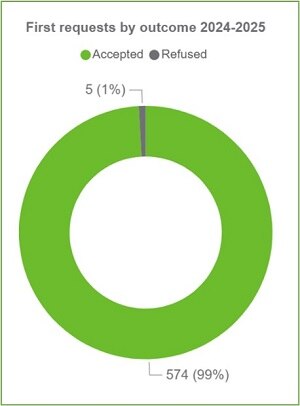
Figure 4 - First requests by outcome 2024-25
2. Doctor completes a first assessment
Once a person has had their first request accepted by a participating medical practitioner, that practitioner becomes the coordinating medical practitioner for the patient. The coordinating medical practitioner must then undertake a first assessment to determine whether the person meets the eligibility criteria for voluntary assisted dying as defined under section 26 of the Act.
A medical practitioner can only undertake a first assessment once they have completed and passed the mandatory medical practitioner training to enable them to participate in voluntary assisted dying.
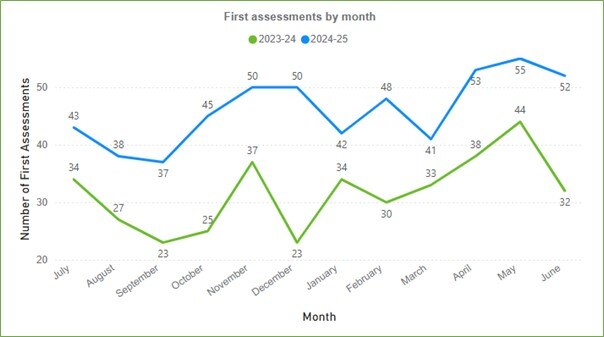
Figure 5 — first assessments
Of the 574 people who had their first request to access voluntary assisted dying accepted in 2024-25, 554 people (96%) underwent a first assessment.
Figure 5 shows an upward trend in first assessments over the past 2 years with an average of 46 per month in 2024-25 up from an average of 32 per month in 2023-24.
Reasons for not proceeding from a first request to a first assessment include:
- the person deciding to withdraw from the pathway
- the person losing decision-making capacity
- the person dying prior to the first assessment.
Figure 6 shows the outcome of the 554 first assessments in 2024-25; for 514 (93%) first assessments the person was assessed as eligible for voluntary assisted dying.
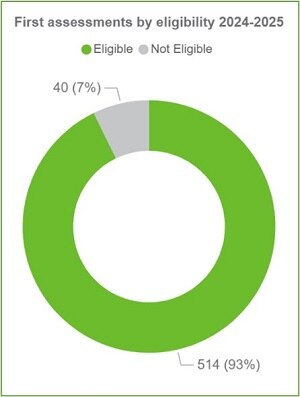
Figure 6 — First assessments by eligibility
3. A consulting doctor completes a second assessment
If a person has been deemed eligible for voluntary assisted dying at a first assessment, the coordinating medical practitioner must refer the person to another voluntary assisted dying trained medical practitioner to undertake a consulting assessment. If the trained practitioner accepts the referral, they become the consulting medical practitioner.
In 2024-25 there was an average of 38 consulting assessments per month, up from 26 per month in 2023-24.
The consulting medical practitioner must undertake a consulting assessment (which is similar to a first assessment) to determine whether the patient is eligible for voluntary assisted dying.
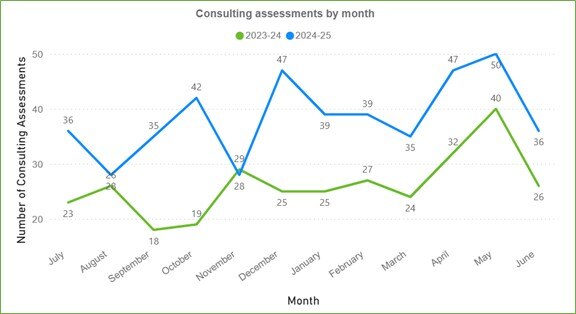
Figure 7 - Consulting assessments by month
In 2024-2025 there were 462 consulting assessments and 459 people were assessed as eligible for voluntary assisted dying at the consulting assessment. Reasons for not progressing from a first assessment to a consulting assessment include:
- the person deciding to withdraw from the pathway
- the person losing decision-making capacity
- the person dying prior to the consulting assessment.
Once a person has been deemed eligible for voluntary assisted dying by both a coordinating and consulting medical practitioner, the coordinating medical practitioner supports the person to complete the necessary next steps in the pathway in order to be able to apply for a voluntary assisted dying permit. These include completing a written declaration, making a final request and choosing a contact person.
4. Complete a written declaration to access voluntary assisted dying
Once a person has been deemed eligible for voluntary assisted dying by both the coordinating medical practitioner and consulting medical practitioner, they must sign a written declaration requesting to access voluntary assisted dying in the presence of the coordinating medical practitioner and two eligible witnesses.
5. Make a final request for voluntary assisted dying
After signing the written declaration, the person must make a third and final request for voluntary assisted dying to their coordinating medical practitioner. This request must be made clearly and unambiguously and can be made verbally or by gestures or other means or with the support of an interpreter.
6. Choose a contact person
Once a person has made a final request for voluntary assisted dying, they must appoint an eligible contact person to return any unused voluntary assisted dying medication to the South Australian Voluntary Assisted Dying Pharmacy Service (SAVAD-PS) within 15 days of their death.
7. Doctor completes a final review
Once the person has appointed a contact person, the coordinating medical practitioner must complete a final review to check that they have completed the request and assessment process in line with the Act, prior to submitting an application to SA Health for a permit to prescribe the voluntary assisted dying medication.
Voluntary assisted dying permits
Once a coordinating medical practitioner has completed a final review, they must submit an application for a voluntary assisted dying permit to SA Health. The application can either be for a self-administration permit or for a practitioner administration permit. In South Australia, the coordinating medical practitioner can only apply for a practitioner administration permit if they are satisfied that the person is physically incapable of self-administration or digestion of the voluntary assisted dying substance.
Reasons why a person may not be issued with a voluntary assisted dying permit include:
- the person died prior to the permit being issued
- the person withdrew from the pathway
- the person became ineligible due to loss of decision-making capacity.
Table 2 – Permit applications by type
| 2023-24 | 2024-15 | |
|---|---|---|
| VAD permit applications submitted |
279 | 406 |
|
VAD permit application outcomes*: issued
|
250 | 387 |
| VAD permit application outcomes*: not issued |
20 | 4 |
|
VAD permit application outcomes*: revoked |
4 | 19 |
| Types of permits: Self-administration | 230 (91%) | 343 (84%) |
|
Types of permits: Practitioner administration
|
24 (9%) | 63 (16%) |
| Number of people issued with a permit** |
250 | 387 |
| Number of people who changed from self to practitioner administration under section 71 of the Act |
4 (0.16%) | 19 (0.5%) |
* The number of permit applications submitted within a reporting period may be different from the number of permits outcomes in the same period.
** The number of people issued with a permit is different from the number of permits issued as some people are issued with more than one permit due to a change from self-administration to practitioner administration. In these instances, the first permit is revoked prior to the issue of the second permit.
There was an average of 34 permit applications per month in 2024-25, an increase from an average of 23 applications per month in 2023-24. A higher proportion of practitioner administration permits were issued in 2024-25 compared with 2023-24.
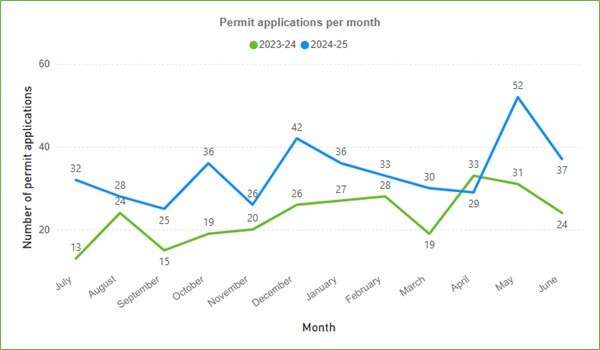
Figure 8 - Permit applications per month
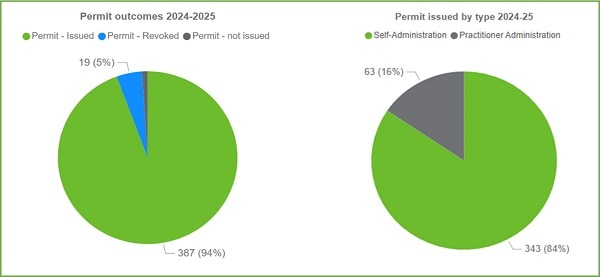
Figure 9 - Permit outcomes and permits issued by type 2024-25
In some circumstances a person may be issued with one permit, and later a second permit. For example, a person may be granted a self-administration permit and later lose the physical capability to self-administer or digest the substance, in this case the person can request their coordinating medical practitioner apply for a practitioner administration permit. In these instances, the self-administration permit is revoked, and a new practitioner administration permit is issued.
8. Doctor prescribes substance once permit approved
Once a voluntary assisted dying permit has been issued, the coordinating medical practitioner must submit a prescription for the voluntary assisted dying substance to the SAVAD-PS.
After the prescription has been sent to the SAVAD-PS, a person who is the subject of a self-administration permit must contact the SAVAD-PS to arrange for a supply visit from the SAVAD-PS team.
During the supply visit, the pharmacist supplies the substance and provides comprehensive education regarding the storage and administration of the substance, as well as the role of the contact person in returning the locked box and any remaining contents after the person has self-administered. Feedback from patients and families indicates the education from pharmacists about managing the substance is undertaken in a skilled, sensitive and compassionate manner.
In the case of a practitioner administration permit, once the prescription has been sent to the pharmacy the coordinating medical practitioner can contact the SAVAD-PS to arrange for delivery of the practitioner administration kit.
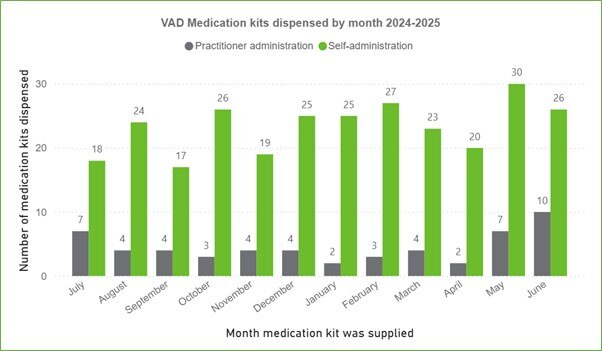
Figure 10 - VAD medication kits dispensed by month
Between 1 July 2024 to 30 June 2025, the SAVAD-PS completed 334 visits across South Australia to supply the voluntary assisted dying substance.
- Of the 334 kits dispensed, 280 were for self-administration and 54 were for practitioner administration
- 32 of the 54 practitioner administration kits were for intravenous administration and 22 were for enteral administration
- There was an average of 28 kits supplied per month in 2024-25, an increase from an average of 20 per month in 2023-24.
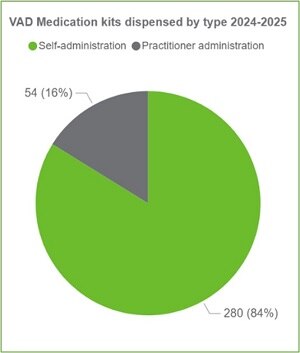
Figure 11 - VAD medication kits dispensed by type
10. Decide to administer substance
Once a person receives the voluntary assisted dying medication kit, they can decide if and when they want to administer the substance. In the case of practitioner administration, the person alerts the coordinating medical practitioner and a mutually agreed time is arranged. A person is under no obligation to take the voluntary assisted dying medication at any point. After the person’s death, the person’s family, friends or support persons will notify a doctor and funeral director as they would with any other death.
11. Death certification
A doctor is required to certify the death on a Doctor’s Certificate of Cause of Death and provide this to the Registrar of Births, Deaths and Marriages (BDM).
The Doctor’s Certificate of Cause of Death allows for the certifying doctor to indicate whether the person who has died was the subject of a voluntary assisted dying permit and, if so record both the manner and underlying cause of death as well as the location of death.
In the case of a person who has administered the voluntary assisted dying substance, the manner of death is recorded as voluntary assisted dying, and the cause of death is recorded as the underlying disease, illness, or condition for which the person was eligible for voluntary assisted dying. To uphold the privacy of patients and families, only the cause of death is listed on the official death certificate issued by BDM.
The Registrar of BDM notifies the Review Board of all voluntary assisted dying deaths.
Between 1 July 2024 to 30 June 2025, 353 individuals with a voluntary assisted dying permit died for one of the following reasons:
- 200 (57%) people died from self-administration of the voluntary assisted dying substance
- 51 (14%) people died from practitioner administration of the voluntary assisted dying substance
- 102 (29%) people died without administration of the voluntary assisted dying substance.
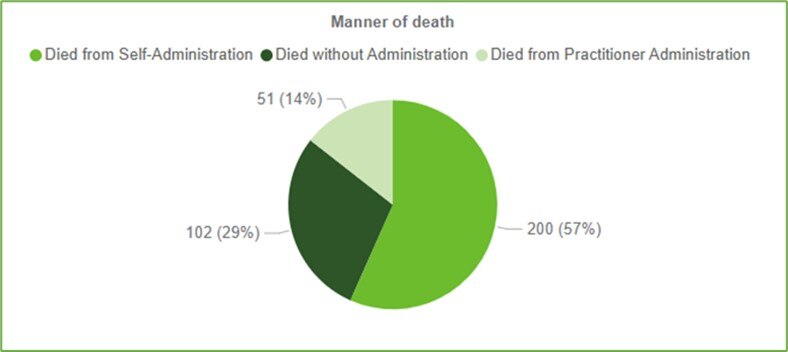
Figure 12 - Manner of death
Of the 353 people who died who were the subject of a permit:
- 261 (74%) had advanced progressive cancer (malignancy) as the disease for which they were eligible for voluntary assisted dying
- 30 (8.5%) had a neurodegenerative disease
- 17 (5%) had heart failure
- 15 (4%) had respiratory diseases
- 30 (8.5%) had end stage organ failure.
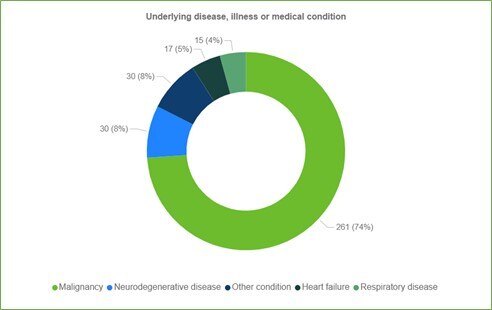
Figure 13 - Underlying disease, illness or medical condition
Of those 353 people:
- 157 (44%) died in a private residence
- 120 (34%) died in a public hospital
- 38 (11%) died in a residential aged care facility
- 28 (8%) died in a hospice or palliative care unit within a public hospital
- 8 (2%) died in a private hospital
- 2 died in other locations.
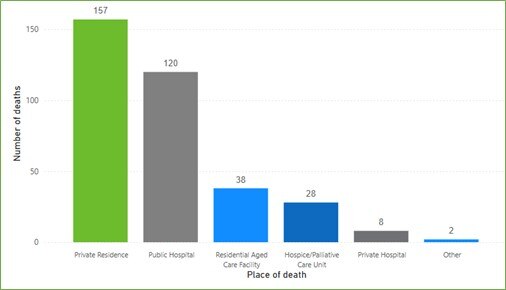
Figure 14 - Place of death
Demographics of voluntary assisted dying applicants
Data collected to date indicates that applicants for voluntary assisted dying in South Australia are diverse, with 57% identifying as male and 43% as female. While a typical applicant is male, in their 70s, Australian-born, living in a private residence in metropolitan Adelaide, and receiving palliative care for terminal cancer, applications are received from people of all genders, ages, and backgrounds.
Table 3 – Applicant demographics
| 2023-24 | 2024-15 | Comparison with SA population | |
|---|---|---|---|
| Median age and range (years) | 73 (29-99) | 75 (25-104) | - |
| Gender: male | 53% | 57% | 49.3% |
| Gender: female | 47% | 43% | 50.7% |
| Postcode: metropolitan | 67% | 65% | 71% (18+) |
| Postcode: regional | 33% | 35% | 29% (18+) |
| Receiving palliative care whilst accessing VAD |
80% | 81% | - |
| Born in Australia |
39% | 70% | 71.5% |
| Aboriginal or Torres Strait Islander |
1% | 1% | 2.4% |
| Required an interpreter |
1% | 1% | - |
| Cancer as primary diagnosis |
77% | 73% | - |
The age distribution of the 554 applicants in the 2024-25 year is shown in figure 15 below.
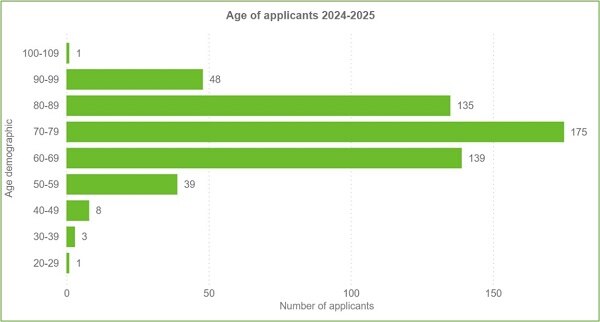
Figure 15 - Age of applicants
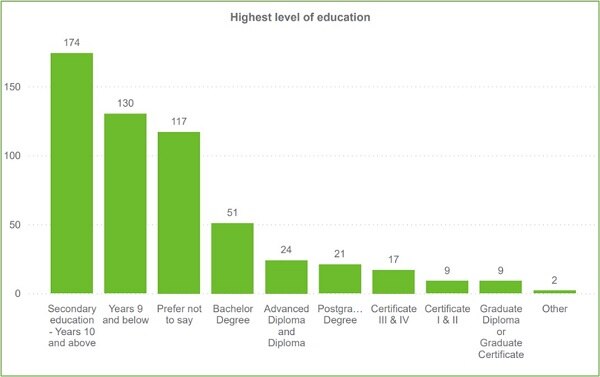
Figure 16 - Level of education
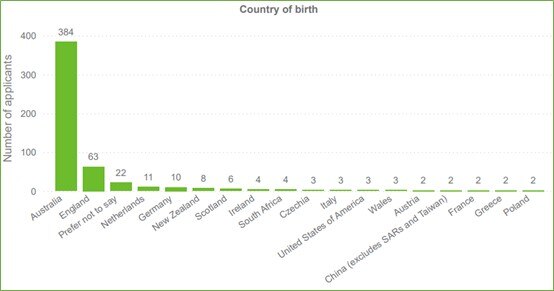
Figure 17 - Country of birth (of the 30 countries represented, only those countries with at least 2 applicants are shown)
Geographic distribution of patients accessing voluntary assisted
Voluntary assisted dying operates across South Australia with medical practitioners supporting patients across SA Health Local Health Network (LHN) catchments.
Of the 554 patients who underwent a first assessment for voluntary assisted dying between 1 July 2024 and 30 June 2025, 358 (65%) lived in metropolitan areas and 193 (35%) lived in regional areas.
An increasing number of patients from regional areas are receiving support to access voluntary assisted dying from medical practitioners who are also based in regional areas. In 2024–25, 88% of first assessments for patients in regional areas were conducted by practitioners located within a regional Local Health Network (LHN), up from 81% in 2023–24.
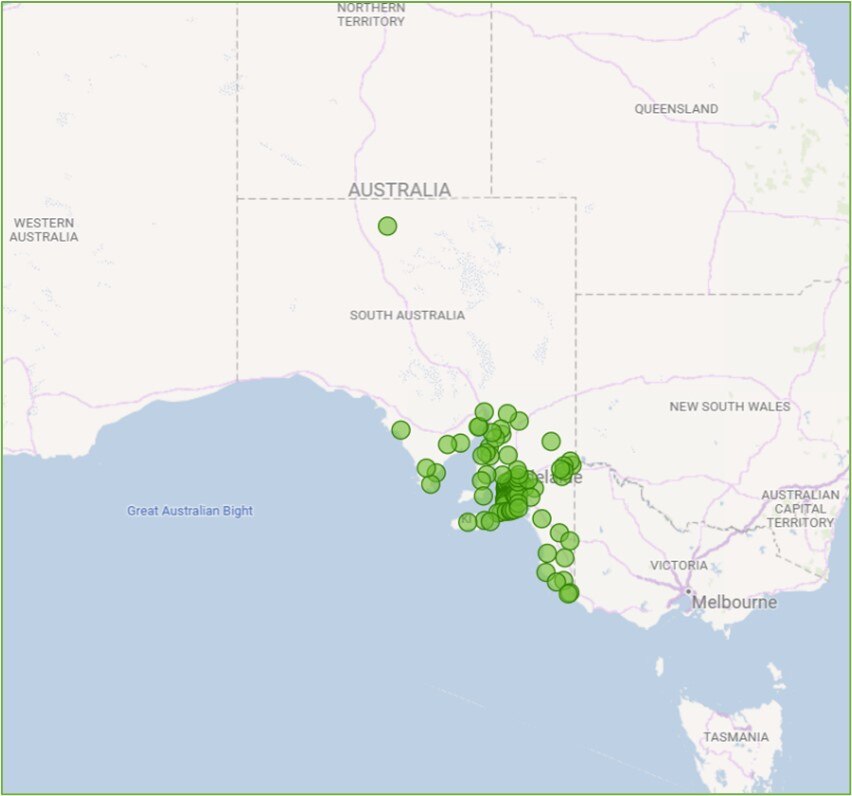
Figure 18 - VAD applicants by postcode
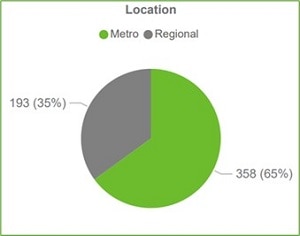
Figure 19 - Location of VAD Applicants
Table 4 - Applicants by Local Health Network catchment
| Local Health Network (LHN) | LHN population 18+ | Participating VAD practitioners by LHN | First assessments by LHN of patient | First assessments by LHN of Practitioner |
|---|---|---|---|---|
| Central Adelaide LHN | 27% | 27 (43.5%) | 134 (24%) | 140 (25.2%) |
| Northern Adelaide LHN | 23% | 6 (10%) | 105 (19%) | 101 (18.2%) |
| Southern Adelaide LHN | 21% | 10 (16%) | 121 (22%) | 177 (32%) |
| Barossa Hills Fleurieu LHN | 12% | 7 (11%) | 86 (16%) | 73 (13.2%) |
| Yorke and Northern LHN | 4.5% |
5 (8%)
|
41 (7%) | 39 (7%)
|
| Riverland Mallee Coorong LHN | 4% |
4 (7%)
|
20 (3.5%)
|
16 (3%) |
| Limestone LHN | 4% |
1 (1.5%)
|
25 (4.5%) | 1 (0.2%)
|
| Flinders and Upper North LHN | 2.5% |
1 (1.5%)
|
6 (1%) | 7 (1.2%) |
| Eyre and Far North LHN | 2% |
1 (1.5%)
|
16 (3%) | 0 |
| Total | 100% | 62 (100%) | 554 (100%) | 554 (100%) |
Individuals who commenced but did not complete the voluntary assisted dying pathway
For a range of reasons some individuals commence the voluntary assisted dying pathway but do not progress to receiving a VAD permit. Between 1 July 2024 and 30 June 2025, 165 people who had commenced the VAD pathway discontinued the pathway without receiving a VAD permit. Reasons for this were as follows:
- 96 (58%) people died prior to receiving a VAD permit
- 46 (28%) people became ineligible (for example they lost decision-making capacity)
- 14 (8%) people were assessed as ineligible for voluntary assisted dying at the first or consulting assessment
- 9 (5%) people withdrew from the pathway.
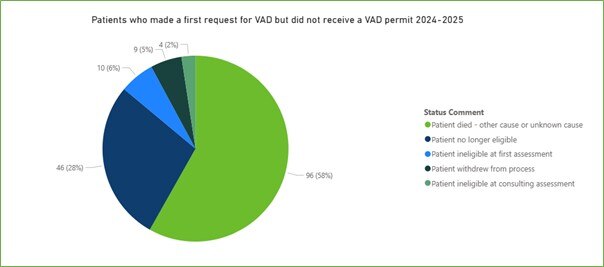
Figure 20 - Patients who did not receive a VAD permit
How long does the voluntary assisted dying application process take?
Between 1 July 2024 and 30 June 2025, the median number of days between a person making a first request for voluntary assisted dying and being issued with a voluntary assisted dying permit was 18 days, with a range from 2 to 427 days.
The median number of days between a person being issued with a voluntary assisted dying permit and their death from administration of the VAD substance was 10 days, with a range from 0 to 446 days. It is clear from these figures that for a range of reasons some people outlive their initial prognosis.
Table 5 - Timeframes on the VAD pathway
Table 4 - Applicants by Local Health Network catchment
| |
Median calendar days and range for deaths in 2024 - 2025 |
|---|---|
| Date of first request for VAD to date of permit decision |
18 (2 to 427) |
| Date of permit issue to date of death from self-administration |
13 (0 to 446) |
| Date of permit issue to date of death from practitioner administration |
3 (0 to 318) |
| Date of permit issue to date of death without administration |
26 (0 to 458) |
The median timeframe is reflective of timeframes for the majority of people on the pathway. Longer timeframes reflect patient preference or in some cases extra time required to undertake assessments to determine eligibility.
Once a person has been issued with a voluntary assisted dying permit, that person has full autonomy and control over the timing of the next steps on the pathway. This means that there can be a substantial variability in the time it takes between a permit being issued and the person making the decision to administer the substance.
Medical practitioner involvement in voluntary assisted dying
As of 30 June 2025, a total of 138 medical practitioners were registered to undertake the mandatory practitioner training to support access to voluntary assisted dying a 9 percent increase from the previous year. Of those, 98 (71%) are located in metropolitan Adelaide with the remaining 40 (29%) located in regional South Australia.
Of the 138 practitioners who have registered to undertake the mandatory training, 86 practitioners completed the training by 30 June 2025. Three practitioners have since withdrawn from participating in VAD, leaving a total of 83 medical practitioners who are currently eligible to support access to voluntary assisted dying in South Australia. This represents one percent of all registered medical practitioners in South Australia.
Of those who have undertaken the training, 60 (72%) are located in metropolitan Adelaide and 23 (28%) are located in regional South Australia closely reflecting the distribution of the South Australian population.
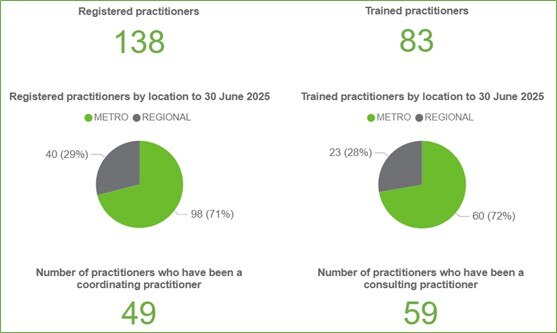
Figure 21 – Medical practitioner participation in VAD
Table 6 – Medical practitioner activity
| |
1 July 2024 | 1 July 2025 | Change year on year |
|---|---|---|---|
| Medical practitioners registered in the VAD clinical portal |
131 | 138 | 9% increase |
| Medical practitioners that have passed the mandatory training |
75 | 83 |
9% increase
|
| Trained medical practitioners as percentage of all registered medical practitioners in SA |
1% | 1% | - |
| Medical practitioners that have participated in VAD |
57 | 62 |
9% increase
|
| Percentage of VAD activity delivered by the top 10 practitioners by volume* |
1 July 2023 to 30 June 2024 — 72% (272 of 380 episodes) |
1 July 2024 to 30 June 2025 — 64% (354 of 554 episodes) |
12% decrease
|
| Percentage of VAD activity delivered by the top 5 practitioners by volume* |
1 July 2023 to 30 June 2024 — 49% (185 of 380 episodes) |
1 July 2024 to 30 June 2025 — 45% (250 of 554 episodes) |
9% decrease
|
| Number of practitioners delivering at least 10 episodes |
13 | 14 |
8% increase
|
| Number of practitioners delivering at least 20 episodes |
7 | 11 |
60% increase
|
* First assessments are used as a proxy for VAD Activity by medical practitioners for this analysis as first assessments are conducted by the coordinating medical practitioner who provides the majority of medical care for patients on the VAD pathway.
A few practitioners are actively participating in voluntary assisted dying. Of the 83 trained medical practitioners, 62 (74%) have provided a voluntary assisted dying service and in the period 1 July 2024 – 30 June 2025, 64 percent of coordinating practitioner activity was provided by only 10 practitioners and 25 percent was provided by just 2 medical practitioners
Medical practitioner roles in voluntary assisted dying
To access voluntary assisted dying in South Australia, a person must have their eligibility for voluntary assisted dying assessed by two medical practitioners who have both undertaken the mandatory training. A medical practitioner who has undertaken the mandatory training is eligible to undertake either role. Not all medical practitioners who have completed the mandatory training are actively engaged in providing access to voluntary assisted dying. For the period 1 July 2024 to 30 June 2025:
- 49 of the 83 trained medical practitioners accepted a first request from a person seeking access to voluntary assisted dying becoming the coordinating medical practitioner for that person
- 59 of the 83 trained medical practitioners accepted a referral from a coordinating medical practitioner to be a consulting medical practitioner
- Many practitioners have undertaken both roles for different patients.
Trained practitioners by specialty
Of the 83 medical practitioners who had completed the mandatory training to support access to voluntary assisted dying in South Australia by 30 June 2025, 42 (50%) are general practitioners, with the other 50% from a range of medical specialities including medical oncology, palliative medicine, general medicine, neurology, emergency medicine, anaesthesia, psychiatry, surgery, geriatric medicine, respiratory and sleep medicine, haematology, addiction medicine and infectious diseases.
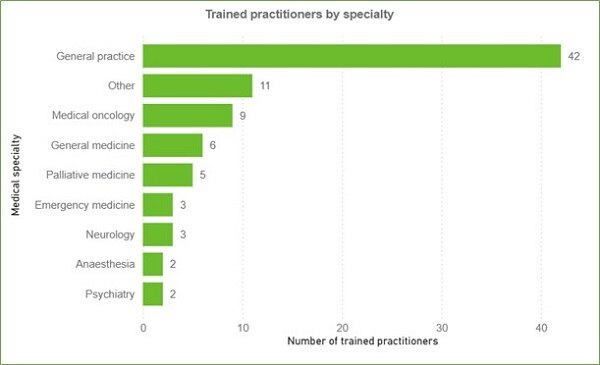
Figure 22 – VAD trained practitioners by medical speciality
Care and support provided to people on the voluntary assisted dying pathway
Care Navigators and VAD Liaison nurse consultants are nursing and allied health professionals with experience in complex end of life care. Care Navigators support patients in the community and VAD Liaison nurses support patients who are in hospital.
Care Navigators and VAD Liaison nurses are available to provide individualised support to each person on the voluntary assisted dying pathway including:
- Responding to requests for information about voluntary assisted dying
- Linking patients with voluntary assisted dying medical practitioners
- Support to organise interpreters
- Support to book appointments
- Referring patients to palliative care and other service
- Supporting patients at appointments for voluntary assisted dying
- Support related to administration of the voluntary assisted dying substance
- Declaring life extinct
- Bereavement support
- Providing assistance and support for family and loved ones throughout the pathway.
Feedback received from patients and families highlights the essential role and the importance of the support provided by Care Navigators and VAD Liaison nurses.
The voluntary assisted dying application process
Each application for voluntary assisted dying requires the submission of a range of prescribed forms to the Voluntary Assisted Dying Clinical Portal (Clinical Portal) by medical practitioners and pharmacists. Some of these forms must be submitted within a specified timeframe after being completed as prescribed by the Act. Prescribed forms include:
- First request form
- First assessment report form (within 7 days)
- Consulting assessment report form (within 7 days)
- Written declaration
- Contact person appointment form
- Final review form (within 7 days)
- Substance dispensing form (within 7 days)
- Practitioner administration form (within 7 days)
- Substance disposal form (within 7 days)
During 2024-2025 3,464 forms were submitted to the Clinical Portal.
Of the 2,088 forms submitted to the VAD Clinical Portal in 2024-25 that were required to be submitted with 7 days, 2066 (99%) met the legislated timeframes.
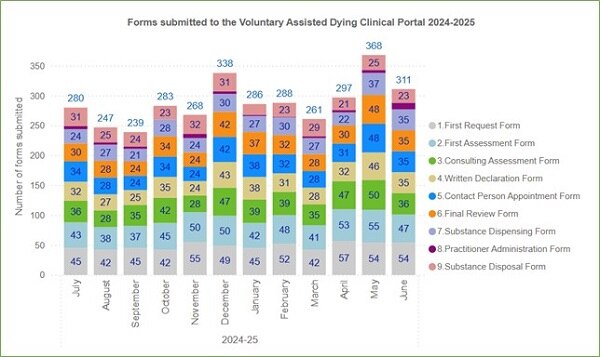
Figure 23 - Forms submitted to the VAD Clinical Portal 2024-2025
Applications for review of a reviewable decision by the South Australian Civil and Administrative Tribunal (SACAT)
If a person seeking access to voluntary assisted dying is deemed ineligible by the coordinating medical practitioner or consulting medical practitioner, they can make an application for review of a reviewable decision to SACAT. Reviewable decisions include whether the person:
- is or is not ordinarily resident in South Australia
- was or was not ordinarily resident in South Australia for at least 12 months prior to making the first request
- does or does not have decision-making capacity in relation to voluntary assisted dying.
During 2024-25 there was one application made to SACAT for review of a reviewable decision. The application was in relation to eligibility on the basis of residency, as the person had not been ordinarily a resident in South Australia for 12 months at the time of the first request.
The Act does not make any provision for there to be an exemption from the duration of residence criterion outlined in section 26 (1) so the application was withdrawn. The person was advised that they could recommence the voluntary assisted dying application process should they wish, once they had been resident in South Australia for 12 months.
Compliance with the VAD Act 2021
Between 1 July 2024 and 30 June 2025, the Review Board conducted a detailed review of 516 individual completed voluntary assisted dying patient pathways in relation to compliance with the Act.
During this period there were 44 non-compliances identified, all of which related to administrative and technical matters. The majority of non-compliance episodes related to the late submission of prescribed forms to the Clinical Portal and did not affect the patient’s eligibility, clinical care of the patient or the voluntary assisted dying pathway for the patient. Reassuringly, the Review Board found no instances of non-compliance relating to coercion, or misuse of the voluntary assisted dying substance.
Referral to other agencies
During this reporting period, the Review Board referred one matter to the Australian Health Practitioner Regulation Agency (Ahpra). There were no matters referred to the Commissioner of Police or the State Coroner.