SA Health air quality monitoring pilot project in Sellicks Beach
Download document
PDF 278 KB
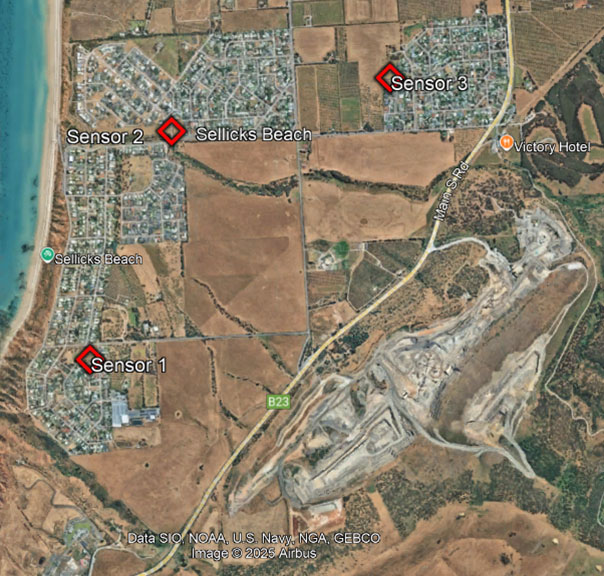
SA Health are testing new air quality sensors in Sellicks Beach to monitor dust in the area.


SA Health are testing new air quality sensors in Sellicks Beach to monitor dust in the area. We'll be installing three new sensors that measure tiny particles in the air (called PM2.5 and PM10) – things like smoke from bushfires and wood heaters, or dust. They are common air pollutants that can affect your health and the environment.
These sensors will work alongside Environment Protection Authority (EPA) SA's monitoring equipment to make sure the information is accurate, and to better understand the dust impacts on the community.
We want to:
The pilot project will start in November 2025 and will run for about 12 months.
The locations of SA Health pilot air quality sensors in Sellicks Beach and the air quality categories are shown below:
Hourly average data is shown, SA Health’s sensor data is updated periodically (approx. 15 mins) and data may not necessarily represent current conditions.
EPA’s Sellicks monitor data can be accessed on the EPA - Air quality monitoring webpage.
You can also check the SA Health air quality information anytime through:
Information on EPA’s monitoring campaign is available on the EPA Adbri - Sellicks Hill webpage.
Information on DHUD monitoring and the interim report is available on the YourSay Sellicks Beach Growth Area Joint Amendment webpage.
For instructions on how to access the Sellicks information on AirRater contact health.chemicalandenvironmentalhazards@sa.gov.au.
Different agencies are measuring different types of air quality at Sellicks Beach.
Measuring: TSP, PM10, RCS.
Why: To understand the dust impacts on the existing community.
When: November 2025 to November 2026.
Measuring: TSP, PM10, PM2.5, RCS.
Why: To understand the potential impacts for the area considered for future residential development to inform the Sellick Beach Code Amendment.
When: November 2024 to April 2026.
Measuring: PM10, PM2.5.
Why: To test new sensors for air quality monitoring.
When: November 2025 to November 2026
These new low-cost sensors are smaller air quality monitors that can monitor pollutants like particulate matter of different size fraction such as PM2.5 and PM10. They are relatively cheap and easy to operate and are becoming a popular way to enhance existing air monitoring networks across the globe. They are not as accurate as ‘reference grade monitors’, but they can provide useful information about air quality, such as trends or changes in air quality in communities, especially if they are part of a network which include reference grade monitors. Low-cost sensors can be beneficial to public health if the community is able to easily access the air quality information in their area and actions can be taken to minimise exposure.
When used alongside ‘reference grade monitors’, data from low-cost sensors can be compared with the reference monitors and used to develop a correction model. The use of low-cost sensors has been validated for PM2.5 especially for use during bushfires. Although, they are generally not considered to be as accurate for PM10, new options are becoming available for measuring PM10 using low-costs sensors as the technology is updated.
TSP are airborne particles generally up to 50 - 100 micrometres in diameter. TSP includes all particle sizes, including smaller sizes such as PM10 and PM2.5.
PM10 particles have a diameter of 10 micrometres or less. Major sources include:
PM2.5 particles have a diameter of 2.5 micrometres or less. Major sources include:
Dust containing RCS is created by certain processes when working with materials that contain silica, such as sand, stone, concrete and mortar.
The outcomes will be shared with the community once the pilot project has been completed.
Contact the Scientific Services Branch, Department for Health and Wellbeing, SA Health:
Phone: 08 8226 7100
Email: mailto:health.chemicalandenvironmentalhazards@sa.gov.au