


Your labour and birth with NALHN
The following is a HTML version of Your labour and birth with NALHN (PDF 854KB) — Produced by the Northern Adelaide Local Health Network, Women and Children's Division.
This guide has been designed by the Northern Adelaide Local Health Network (NALHN) as a useful reference during your pregnancy and in labour, and complements the information you will receive during your antenatal care.
Contact numbers
- LMH Switchboard: 08 8182 9000
- LMH Birthing Suite: (08) 8182 9282
- LMH Birth Centre: (08) 8182 0749
- Women’s Assessment Unit: (08) 8282 1301 or (08) 8282 1303 (7am – 9pm, seven days)
Labour has three distinct stages:
- During the first stage the cervix softens and thins or ‘effaces’ and then gradually opens or ‘dilates’ to a point where it can no longer be felt (10 centimetres).
- In the second stage the baby is pushed down through the birth canal and is born.
- In the third stage the placenta and membranes come away from the wall of the uterus and are expelled.
Although there are three distinct stages of the birthing process, every woman’s labour can be completely different. The way labour begins, the rate it progresses, and the eventual outcome are only a few of the factors that can vary from woman to woman.
Birth plans
Discussing your wishes/plans for labour and birth with the midwife/ doctor involved in your care will enable staff to help you work towards achieving your desired goals.
It is important to keep any plans for your birth open and flexible as unexpected events do occur and interventions may be required for the health and well-being of mother and/or baby.
Probably one of the most important decisions you will make during the first stage of labour is when to come to hospital.
To help you make this decision, we have prepared the following guidelines. We advise that you contact the hospital if you have any of the following:
- when you are having regular painful contractions that are becoming stronger and closer together, and are five minutes apart (or seven minutes if this is not your first baby)
- when your membranes have ruptured (water has broken) – this could be a slight trickle or a sudden gush of fluid of any colour from your vagina
- bright bleeding which is heavier than a normal ‘show’ (vaginal mucous streaked with blood)
- your baby’s movements have changed (increased or decreased)
- you are feeling unwell
- you are concerned or worried
Please call prior to presenting to the hospital in order to gain advice, find out where to go and allow staff to plan for your admission.
Women’s Assessment Unit (WAU) Phone: 08 8282 1301 or 08 8282 1303. The phones divert overnight to Birthing Suite.
Admission
Emergency birthing entrance – For women who are in labour, Lyell McEwin Hospital’s Birthing Suite and Birth Centre has a 24-hour emergency birthing entrance, located off Trembath Road.
If you are being admitted for an induction of labour (IOL), you will be advised to come to Birthing Suite where a bed will be allocated. Your support person will be required to go home by 9pm to get some rest after the process has been commenced because labour will not usually start until the next day. If you do go into labour, they are welcome to return. The midwife can ring them if you are not able to.
If you are having a pre-booked caesarean section, hospital admission is direct to the Women’s Health Ward. Enter the hospital via the Women’s Health entrance, follow signs from the Mark Road multi-deck car park or use pedestrian access via Trembath Road.
Women having care with the obstetric medical team are usually seen in Women’s Assessment Unit (WAU) between the hours of 7am – 9pm. Women should be seen in the WAU to check the progress of labour; out-of-hours assessments are completed in Birthing Suite.
If you are being cared for by the midwives in the Birth Centre, you will be asked to attend the Birth Centre for assessment.
The Lyell McEwin Hospital Women and Children’s Division encourages women to breastfeed and supports the guidelines designed by the World Health Organization and UNICEF to establish and maintain breastfeeding. Dummies are not supplied by the hospital. All families who choose to bottle feed will need to supply their own formula.
Please remember your Pregnancy Hand-Held Record and birth plan.
Please leave any valuable items at home, as Lyell McEwin Hospital does not take responsibility for any lost property.
For you
- your pillow if desired
- maternity bras and nursing pads
- slippers and warm socks
- underpants (firm enough to hold a pad on)
- toiletries
- one packet of sanitary pads
- loose, comfortable clothing
- if you have long hair, please bring a hair tie (without metal in it)
- snacks
For baby
- one packet of disposable nappies
- one packet of nappy wipes
- baby clothes
- for going home: one cotton singlet, one grow suit, two bunny rugs or muslin wraps, booties and a nappy
- in your car – a securely fitted baby capsule or car seat. When taking your baby home from hospital, for safety reasons he/she must be seated in a suitable child restraint when travelling by car
For your partner or support people
We suggest they bring:
- food and drinks to give them energy – these are also available from the Fresh Cafe at the main entrance or from vending machines situated in the Women’s Health Entrance
- jumper and bathers may be needed
- a watch with a second hand can be useful or a contraction timer app
- telephone numbers of people to contact
The birth of a baby is a unique and unforgettable experience in the life of any parent. Being an active participant in your care and that of your baby means taking responsibility, getting educated and asking questions when you need to.
As labour and birth experiences can vary so much, we recommend you read about labour and birth and attend antenatal education sessions. Aim to be prepared for labour, birth and parenting by gathering support during pregnancy and accessing supports offered at the hospital and in the community.
Remember that birth can be unpredictable and unforeseen circumstances can arise. If unexpected events arise, talk with your midwife and support people or a professional about how you are feeling. Debriefing difficult experiences can help to reduce the chances of experiencing post-natal depression (PND) and help you to enjoy your baby.
Lyell McEwin Hospital’s Birthing Suite consists of two areas; Birthing and Assessment Unit which cares for any woman, regardless of her risk factors, and the Birth Centre, catering for low-risk pregnancies. The philosophy of care in both these birthing areas is to provide a woman- and family-centred service, encouraging participation in decision making, reducing family separation and promoting an early return to the home environment.
Birthing and Assessment Unit
Women who have high-risk pregnancies or choose obstetric medical care throughout their pregnancy, or women who require certain interventions during labour (i.e. an epidural), will give birth in Birthing and Assessment Unit.
Length of stay in Birthing Suite
If you choose early discharge (i.e. four hours post birth) and you and your baby meet the criteria, you will be discharged home directly from Birthing Suite. Alternatively, you will be transferred to the Women’s Health Ward within a couple of hours after the birth, where you will stay for the remainder of your post-natal time in the hospital.
Visiting hours in Birthing Suite
- Two support people during labour, birth and postnatal.
Catering for women who have low-risk pregnancies and have elected to have midwifery care throughout their pregnancy and labour. If problems arise through the antenatal period or during labour and birth, referral to the obstetric medical team may be required.
The Birth Centre consists of two teams of midwives and women are allocated to one, either Red or Yellow. The aim of these teams is to provide more continuity of care, in the hope that a woman will meet most of the midwives in her team during her antenatal care.
In line with Birth Centre philosophy, natural forms of pain relief are promoted. The midwives encourage women to be active in labour, moving around and trying various positions. They provide hot packs, bean bags, mats and mediballs and encourage the use of the shower and bath to promote comfort in labour. Water birth can be accommodated under certain criteria upon request.
Gas inhalation and morphine injections are also provided as medical forms of pain relief if needed. If an epidural is requested during labour, it is necessary to transfer to the Birthing Suite. Women who transfer to the Birthing Suite do not return to the Birth Centre after birth but go to the Women’s Health Ward for the remainder of their stay at the hospital.
Support people are encouraged in the Birth Centre and are an integral part of helping a woman through the birth process more easily. However, too many people can be distracting and disruptive to the labouring woman, so this should be considered prior to labour commencing. If children are to be at the birth, someone needs to be available to supervise and support them during labour and birth.
When women present to the Birth Centre in labour, every effort is made to allocate a midwife from their own team to care for them. Women who are part of the Birth Centre are encouraged to phone the midwives if they have any concerns during their pregnancy or think they may be in labour.
For advice 24 hours a day, seven days a week, please phone 08 8282 0749.
Length of stay in Birth Centre
Length of stay is usually four to 24 hours after birth. There are criteria that need to be met for both you and your baby prior to discharge. As you can appreciate, we want all women booked with the Birth Centre to have the opportunity to have their baby here. There may be occasions where transfer to Women’s Health Ward may be required or length of stay may be less than you originally anticipated. This will always be negotiated with you.
After the birth of your baby, you may be able to spend the next 24 hours in the Birth Centre before being discharged home or transferred to the Women’s Health Ward should you choose to stay in hospital longer. Women who are transferred to Women’s Health Ward cannot have their partner stay with them overnight and will most likely be in a shared room.
Follow-up at home is with the Home Visiting Midwife and an optional Mothercarer. Enrolment with the Mothercarer service before the birth is advisable for women who wish to take up the option.
Feedback about experiences of having a baby with us is welcomed. You are encouraged to talk to us or write to us. Updates and baby photos are especially appreciated and are displayed on pin boards around the unit.
Visiting hours in Birth Centre
- Two support people during labour, birth and postnatal.
Photographing and videoing the labour and birth
In both the Birthing Suite and the Birth Centre, cameras (including video cameras and phone cameras) are welcome to capture this special event.
However, the actual birth may only be filmed after prior consultation with the staff involved in your birth. In some situations, filming may be inappropriate, and we ask that you respect staff privacy and wishes.
Please seek permission from staff if you are photographing them and/or uploading images or videos to social media.
Video cameras are not permitted in the operating theatres.
Relaxation is a tool that can help relieve the stresses of everyday life. It can protect the body organs from unnecessary wear and tear; it can boost the immune system and can calm the mind. Many people, however, find it hard to relax.
Pregnancy is an excellent time to learn a couple of relaxation techniques. Your body is using more energy to supply your baby’s needs, so pregnant women tend to tire easily. Fatigue can lead to generalised body tension which can be relieved by relaxation. Everyone can benefit from relaxation, so involve your partner or support person whenever possible.
Passive relaxation
In pregnancy, the first time you do your relaxation it is a good idea to do it lying on your side. Later you can progress to sitting fully supported (for example, in a comfortable armchair, avoiding reclining positions).
How:
- Aim to set aside about 15 to 20 minutes at a time of the day when it is quiet and you are not likely to be interrupted.
- Lie on your left side, with your head on a pillow, knees bent and your right leg resting on a pillow. Your whole body should be fully supported and comfortable.
- Close your eyes.
- Make any final adjustments to your position.
- Take three deep breaths in and out. Pause at the end of each breath out.
- Feel your body getting heavier each time you breathe out, slowly becoming aware of the small sounds around you – nature or distant traffic.
- Starting from your toes, check the whole of your body for any tension.
- Become aware of your breathing – not controlling it, but observing the air going in and out. It may be helpful to say the word ‘relax’ to yourself on the breath out.
- Continue with this for about 15 to 20 minutes.
- When you are ready, become aware of the small sounds once again, and of the room around you and your position.
- Stretch or yawn if you want to.
- Slowly open your eyes. Wait a little while before you get up, allowing your body to adjust to its changed state. Get up very slowly.
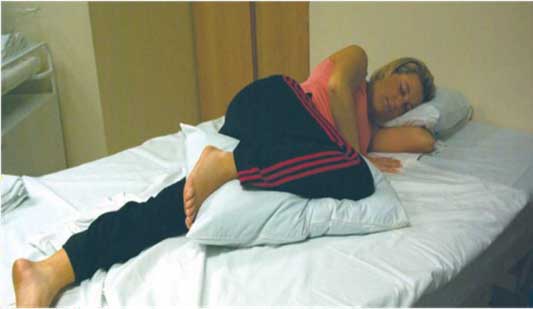
Image: example of passive relaxation position
Tips for labour
- Comfort, company and being in control can help you to relax in labour.
- Have confidence in yourself and trust your instincts, ability and resources – your body knows how to birth your baby.
- Understanding the birth process and accepting labour as normal and natural is the first step towards pain management.
- Try a range of positions and pain relief strategies.
- Be honest with your partner or support people and express any fears or concerns you may have.
- Relax, breathe naturally and move with the pain.
- Face each contraction with determination. Visualise your cervix opening and your baby moving down.
- If you feel you can’t do it any more, push yourself a little further.
- Make noise if you want to – by releasing tension from your body you are helping your body to give birth to your baby.
- Remember that pre-labour can last 24–48 hours before labour establishes. Don’t watch the clock!
- Labour is an unknown journey. Whatever your requirements are for pain, or how you give birth, be proud of your achievement. You don’t fail labour!
Labour can be a stressful event and it is hard work. Your initial response to labour contractions may be to ‘hold tight’; however, this reaction is not helpful. Fear leads to tension which leads to pain.
When fear, stress and tension are present, sometimes the uterus doesn’t work efficiently because:
- the surrounding muscles are tight
- tension in the muscles of the rest of the body uses up valuable oxygen and energy that the uterus needs
- it is thought that tension may overflow to the involuntary muscle of the cervix so that it takes longer to dilate
- the hormones released when you are tense have an adverse effect on the ability of the uterus to contract, which may make labour longer
Relaxation, or ‘letting go’, can assist the labour process because:
- it conserves your energy
- it allows you to ‘centre’ on the ‘work’ to be done
- it enhances the release of oxytocin
- pain is felt less when you are relaxed
- it increases oxygenation to your baby
Your partner or support person can help you to relax in labour by:
- identifying any tension you may have
- reminding you verbally to relax
- using touch relaxation
Specific relaxation techniques learnt and practised during pregnancy can be valuable in labour.
Quick release technique
When you are feeling tense, or you find it difficult to find time for passive relaxation, a quick relaxation technique may help. Take three deep breaths in and out. On the breath out, release your body tension by:
- smoothing your forehead
- relaxing your jaw
- dropping your shoulders
Differential relaxation
A more conscious relaxation technique may be helpful in labour. As you will not be in one position the whole time during labour, this technique should be practised in several positions.
- Simply tighten one part of your body, such as your arms. Check the rest of your body for any tension and if any is felt, relax the area and let it ‘flow out’. Now relax your tightened arm.
- The tightened arm represents the contracting uterus. Practise this technique daily, as it will make it easier for you to relax in labour, especially when your uterus contracts.
Breath awareness
Relaxation and breathing are so closely associated that it is important to explore them together. Slow, deep rhythmic breathing helps to clear the mind and promotes relaxation.
Try this simple exercise:
- Sit comfortably on the floor or a chair.
- Close your eyes and let go of the tension. Let your shoulders drop. Soften your face. Release your belly and pelvic area.
- Place your hands horizontally on the lower edge of your ribs with your fingertips almost touching in the middle.
- Feel your hands rise and separate as you breathe in deeply through your nose, and feel them move back as you breathe out through your mouth.
- Do this three to four times and then relax.
- Now, keeping your eyes closed, lower your arms to a resting position.
- Breathe in deeply through your nose and then slowly breathe out through your mouth, relaxing all your muscles as you do.
- Repeat this exercise several times and then relax.
Focusing on a body rhythm, such as breathing, can help you to release tension, so practise this simple exercise daily and use this technique whenever you are tense.
In labour, you should breathe as slowly and deeply as you find comfortable during your contractions. Focus on your breath out during your contraction, as it should help you to relax and ‘let go’ of your tension.
Don’t try to override your normal pattern of breathing. You don’t need to learn specific breathing techniques for labour, as your body will automatically adjust the rate and depth of your breathing as labour progresses.
If you are fearful and/or panic, you may unconsciously hold your breath. If this happens, your partner or support person should begin to breathe as you were, as you will mimic their behaviour.
You may begin to hyperventilate (become light-headed or dizzy) during a contraction. If this happens, cup your hands over your mouth and nose and breathe through your cupped hands for a minute or so.
Panting is a technique that is often used during the transition stage of labour and/or for very painful contractions. It is a very fast, shallow form of breathing which incorporates a gentle blow out on every second or third breath.
During the last weeks of your pregnancy you may notice the following signs that your body and the baby are preparing themselves for labour:
- your baby’s head engages into your pelvis – this normally happens two to four weeks before labour begins if you are expecting your first baby
- pelvic pressure increases
- Braxton Hicks contractions (the tightening of your uterus) occur more frequently and can sometimes be quite regular and uncomfortable
- mucous discharge from the vagina may increase
- you may have a burst of energy
- slight diarrhoea may occur
- you may have a ‘show’, which is mucous streaked with blood
The first stage of labour
During this stage of labour, the cervix softens and gradually opens until it can no longer be felt, and the baby’s head moves down into the pelvis.
- You may notice either or both of the following signs as it begins: contractions felt as period cramps, backache or groin pain, and the uterus will feel hard at the same time
- a sudden gush or slow leak of amniotic fluid. The waters may break before your contractions begin
The length of first stage varies greatly – some women experience hours or even days of pre‑labour or false labour before true labour begins.
For this reason, when you are at home please remember to:
- conserve your energy – continue with your usual activities during the day if they are not too strenuous. If labour begins at night, try to rest or sleep
- have a shower and/or go for a walk if you are feeling tense, but don’t get too tired
- drink and eat something light and nourishing if you are hungry
- check your bags are packed
- contact your partner or support person as required
- company is a good idea
- ring the hospital at any time you would like advice, when your waters break and/or when you think it is time to go. Be guided by the staff member’s advice
As labour progresses you will notice that your contractions will begin to form a pattern – they will become regular, more frequent and stronger. It can be helpful to time these. Many pregnancy apps incorporate a contraction timer.
Where you feel the pain varies – it could be in your back, low in your pelvis or across your abdomen.
At some stage you will find that when a contraction occurs you will stop what you are doing and will have to concentrate on your breathing until the pain subsides.
As the pain increases you will probably begin to use other pain‑relieving strategies, such as pelvic rocking.
Positioning
- To relax in labour, you must be comfortable.
- Try to stay upright and walk around for as long as possible.
- Use pillows, bean bags, chairs or other people for support to help make you comfortable and allow you to relax.
- Pelvic rocking will help to ease backache and encourage your baby to turn and descend.
- Try a new position if you are no longer comfortable.
Try these positions during your pregnancy to determine which you prefer, remembering that it is important to be adaptable during labour.
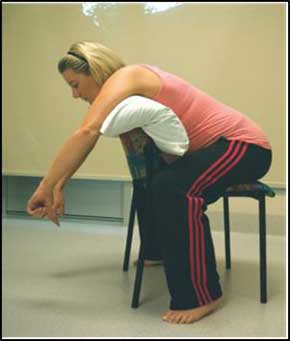
Image: pelvic rocking on a chair
Touch relaxation and stroking
These techniques can be quite soothing, particularly if they are done in the rest period between contractions. Your partner or support person should look for signs of tension in your body, as these are the areas that will benefit from stroking.
Remember some women don’t like to be touched in labour, so your partner should check before starting.
Note: The following description and instructions are for your partner or support person; therefore, ‘you’ refers to them.
Face – Use your fingers to apply gentle pressure to the side of the face, then stroke from the centre of the forehead down towards the ears.
Shoulders – Use the palms of the hands to stroke from the base of the neck, across the shoulders, down the arms and right to the tips of the fingers.
Thighs, legs and feet – Use your hands as above to stroke from the hip joints across the top of the thighs, to the knees and down to the lower legs, ankles and feet.
Back – Slowly stroke the full length of the spine with one or both hands.
Massage
Massage can be very soothing as it relieves pain as well as increasing circulation to an area. Women may find it helpful to have firm massage to a specific area during a contraction, as it can mask the pain they are experiencing.
The amount of pressure required to be effective varies greatly, so your partner or support person should check with you before they begin.
An oil or lotion should be applied to your skin to decrease the amount of friction from the massage.
Back massage – With one hand resting on the shoulder, move the other hand slowly, deeply and rhythmically over the skin of the whole back.
Specific massage – Use the palms of the hands to move the skin over a specific area of pain in a circular motion. Your palm should remain in contact with the skin.
Knuckle massage – Often used for a posterior presentation baby to relieve pain from sacral pressure. Use the knuckles of the hand to move the skin against the sacrum in a slow, very deep circular movement, or up and down.
Sacro-iliac joint massage – Knead the skin over the sacro-iliac joints with your thumbs or fingers.
Abdominal massage – Gently stroke the skin over the uterus in a circular motion. Women often prefer to do this themselves.
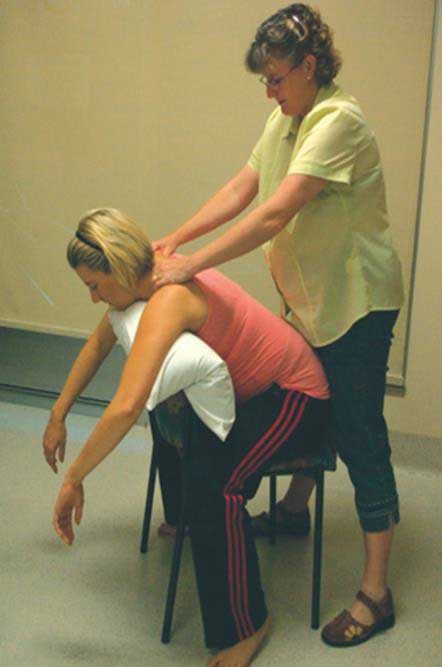
Image: example of massage during labour
Pressure points
Pressure applied to certain points on the body can interfere with the transmission of pain messages to the brain and pain can be reduced. The pressure applied should not be so firm that it causes pain itself.
Buttocks – This is done with the woman on her side. Make sure the hips are bent to make it easier to find the correct pressure point. Press your thumbs on the inside of the lowest bony joints of the pelvis.
Soles of the feet – Press your thumbs on an area between the pad of the big toe and the pad of the other four toes.
Heat
Heat is a useful medium for providing pain relief in labour, as it promotes muscle relaxation. It can be applied either directly to an area of intense pain or as a more generalised form of pain relief in the form of a warm bath or shower.
In labour, a hot pack is the simplest and most effective way of applying heat to a localised area of pain. A variety of hot packs are available for use at home; however, a warm, wet towel or nappy can be just as effective. Hot packs are provided at hospital.
As well as enhancing muscle relaxation, soaking in a warm bath can be advantageous because:
- the warm water increases venous pressure and returns blood to the heart more efficiently
- the water counteracts the forces of gravity
- it may decrease pressure felt against the back and buttocks
Showers and deep baths are available in the Birthing Suite.
TENS machine
The Transcutaneous Electrical Nerve Stimulation (TENS) machine delivers small electrical impulses directly to the skin. This can reduce the pain signals going to the spinal cord and brain, reducing pain. The TENS may also stimulate the release of endorphins, which are the body’s natural painkillers.
TENS machines can be hired or bought privately and are commonly used for pain relief in labour. If this is something you would like to use, you can make your own arrangements during pregnancy, or ask your care provider for a referral to the Lyell McEwin Hospital Physiotherapy Department. A physiotherapist can show you how to use the TENS machine and hire you a unit for use in labour.
Emotional support tips for your partner or support person
Talk to your partner beforehand to find out what she does and doesn’t want during labour. You may need to let the midwife know. Just being there is often enough to make a woman feel more at ease.
Give encouragement and praise – and lots of it. Communicate love and support non‑verbally through touching, back rubs, massage, holding her hand, wiping her brow, offering drinks, ice cubes or hot packs.
Encourage her to remain upright and help her change positions. If you must leave, let her know when you will be back so she doesn’t worry. Always let her know what is happening.
Encourage her to deal with one contraction at a time. Forget about the last one and try not to focus on the next. There may be contractions that make her feel panicky or out of control – encourage her to regain control with the next contraction.
It is hard work being a support person. Rest when you can and remember to eat and drink.
Reminders for the first stage of labour
- listen to and trust your body – it knows what to do
- stay at home for as long as you feel happy there
- call the hospital if you have any questions – support is available 24 hours a day
- be honest and share your feelings
- eat and drink what you feel like in early labour
- empty your bladder frequently
- note the colour of your waters if they break and tell the midwife
- ask for help or guidance when you need it
Image: ????
Nitrous oxide (gas)
This is a short-acting analgesic gas that is inhaled through a hand-held mouthpiece. ‘The gas’ or ‘laughing gas’ as it is commonly called, is combined with oxygen in a ratio that can be varied according to individual needs.
Its effect will become apparent after several deep breaths, and will continue until you stop breathing it in. It may be used with each contraction if needed. It will only provide adequate pain relief if it is used correctly. The midwife caring for you will teach you how this is done.
Advantages
- It is non-harmful to the mother and baby.
- It does not have a cumulative effect (it won’t build up in your system).
- It alters your perception of pain and may be used during the first stage of labour once labour is well established.
- It can be used to overcome a premature urge to push in the transition stage of labour.
- It may be used in the second stage of labour to prevent pushing while the head is crowning.
Disadvantages
- It may cause drowsiness and/or slight confusion and dizziness.
- It may cause nausea and/or vomiting.
- It may not provide adequate pain relief if it is not used from the beginning of a contraction.
- It is a greenhouse gas, therefore it is not very good for the environment.
Morphine injection
This is a pain reliever that is usually given by injection into the muscle of the thigh or buttock or an injection under the skin. It takes effect in about 15 minutes and lasts about two to four hours. It can have a sedative effect on the mother and baby.
Advantages
- It alters your perception of pain and may lessen its severity.
- It normally produces a relaxed state of mind and so may help the progress of labour.
Disadvantages
- It crosses the placental barrier and may make the baby sleepy. Baby may require medication to reverse the actions of the morphine.
- It may interfere with initiating breast feeding if the baby is sleepy.
- It may create a feeling of light-headedness and floating that can make concentration difficult and so diminish the ability to focus on working with the labour. Subsequently, it may affect memory of events during labour.
- It may cause nausea and/or vomiting.
Epidural
An epidural is local anaesthetic that is injected into the ‘epidural space’ surrounding the spinal cord. It causes temporary, complete or partial loss of sensation from the waist down, and so relieves the pain from uterine contractions. Top-ups are given by you as required to maintain pain relief by pressing a button, or an epidural infusion may be used for continuous pain relief.
Advantages
- The partial loss of sensation from the waist down means it is the most effective way of relieving the pain experienced in labour.
- It allows the mother to be awake during Caesarean section and instrumental delivery (forceps or ventouse).
- By providing effective pain relief it promotes relaxation and so cervical dilatation may occur more rapidly.
Disadvantages
- If top-ups cause some temporary loss of sensation or feeling in the lower limbs, the mother may need to remain upright in bed.
- Epidurals can cause a sudden drop in your blood pressure, and this can sometimes cause you to feel unwell, or cause the baby to temporarily show signs of distress.
- It is necessary to have an intravenous drip, a urinary catheter (in the bladder) and the baby must be monitored throughout labour.
- Sometimes the mother does not have the urge to push and the epidural can be allowed to wear off to encourage this sensation.
- An epidural may slow down the labour process if labour is not well established when given.
- Obstetric intervention, such as forceps or ventouse, may be necessary if the woman’s urge to push is lessened by the effects of the epidural.
- Some aspects of epidural use can impact breastfeeding success. Australian Breastfeeding Association Epidurals and breastfeeding is an informative article on their website.
Spinal (not for pain relief during labour)
A spinal is used when there is a need for intervention such as forceps, ventouse or Caesarean section.
It is a local anaesthetic that is injected into the spinal canal to numb the lower part of your body. Like an epidural, a spinal is given lower down in the spine, but it does not require a catheter to remain in at the site.
Pudendal block
A pudendal block is local anaesthetic injected via the vagina near the cervix to numb the vagina, vulva and perineum. It is used as a form of pain relief when forceps or ventouse are required and the use of an epidural or spinal is not possible.
Local anaesthesia of the perineum
If an episiotomy (surgical cut to the vaginal wall) is required, local anaesthetic may be injected into the perineum and vagina prior to it being performed. This may also be used if suturing of this area is needed following birth.
During this stage, the cervix is close to full dilatation (between seven and 10 centimetres dilated) and contractions are long, very strong and close together. Some women feel as though one contraction cascades into the next and that they don’t get a break. Behavioural changes can also occur, and women sometimes feel confused, irritable and/or depressed.
A labouring woman needs a lot of encouragement at this stage.
She may feel ‘so near and yet so far’. Each contraction can feel like a major hurdle and words of encouragement will give her fresh enthusiasm (for example, ‘You’re going well’, ‘You’re doing a great job’, ‘Keep it up’, ‘You can do it’).
Occasionally, women experience the signs of second stage, such as the urge to push and pressure on the bowel, at this time. It is important not to push until the cervix is fully dilated, as premature pushing can cause the cervix to swell. If you feel like pushing, your midwife should be informed as you may be in the transition stage – the midwife may check the dilatation of the cervix and if it is not fully dilated, you may be asked to pant or change your position to reduce your urge to push.
It is important to note that only a small percentage of women will experience a difficult transition period. The majority will progress smoothly from the first stage of labour to the second stage.
Reminders for the transition stage of labour:
- Express how you feel – you are nearly there.
- Try different positions.
- You will be pushing soon.
- You will be seeing your baby soon.
The second stage is the expulsive stage of your labour, commencing when the cervix has fully dilated and ending with the birth of your baby.
During this stage the combined force of uterine contractions, plus pressure from the diaphragm and abdominal muscles, push your baby down the vagina to the birth outlet. The contractions last about one minute, but the rest periods between them may be longer than those at the end of first stage.
The urge to push, or ‘bear down’, with contractions is normally the signal that second stage has commenced, and this urge is often irresistible. You may feel pressure on the lower bowel and an intense feeling of your baby in your vagina.
There is a range of positions you may like to use during this stage. Try several of them during your pregnancy but, as with your preferences for positioning in first stage, remember that you must be adaptable in labour.
It is important to note that you must rest in a comfortable position between contractions.
The urge to bear down or push in second stage is normally irresistible, but some women need encouragement from their partner and/or staff. Maintaining an upright position can assist the process of birth.
Upright positions for second stage
As the baby’s head reaches the birth outlet, you will feel an intense bulging of the perineum and anal area, and a stinging sensation. This is due to the perineum stretching as the head is crowning.
This process needs to occur slowly so the perineum has time to stretch. Your midwife will keep an eye on the perineum, and she may ask you to pant rather than push.
Relax and use deliberate, quiet, relaxed panting while thinking: ‘Don’t push, pant, don’t push, pant’.
As the birth becomes imminent, your midwife will begin to prepare for the arrival of your baby. At this time, under the supervision of your midwife, you should continue to push when you have an urge and try to keep your pelvic floor and thigh muscles relaxed.
You may like to feel your baby’s head with your hand and/or watch it in a mirror. Remember, if you are asked to stop pushing, particularly for the birth of your baby’s head, try to relax completely and pant. The body of your baby should be born with the next contraction.
Reminders for the second stage of labour
- change your position whenever you need to
- when the urge to push occurs, respond to it wholeheartedly
- relax your pelvic floor
- ask for a mirror if you wish to watch your baby’s progress
- as the shoulders are born, reach down and welcome your baby!
When the baby has been born, he/she is placed skin to skin on your chest and is wiped down with a warm towel.
The baby is visually checked and placed on your chest if both you and your baby are well and healthy.
An injection of oxytocin is offered to you after birth. Optimal cord clamping (delayed cord clamping) is recommended for > 60 seconds or until the cord has stopped pulsating. Your partner is encouraged to cut the cord if that is your wish.
For further information
Cervical Ripening / Induction of Labour booklet, available from your antenatal care provider, clinician or midwife.
References
- Australian Breastfeeding Association. Epidurals and breastfeeding.
- Australian Government Department of Health. Pregnancy Care Guidelines.
- SA Perinatal Practice Guidelines. Normal pregnancy, labour and puerperium management.