Acknowledgement of Country
Barossa Hills Fleurieu Local Health Network acknowledges Aboriginal and Torres Strait Islander peoples as the First Peoples of Australia.
We acknowledge that the lands on which we work and deliver care across the Barossa Hills Fleurieu region are the Traditional Lands of the Kaurna, Ngadjuri, Peramangk, Ngarrindjeri and Ramindjeri peoples.
Through the work of the Rural Support Service and Rural and Remote Mental Health Service, our responsibilities and partnerships extend across many Traditional Lands and Countries throughout Australia. We acknowledge the Traditional Owners and Custodians of these lands, airs and waters, and recognise that connection to Country is central to the social and emotional wellbeing, spiritual, cultural and physical identity of Aboriginal and Torres Strait Islander peoples.
We pay our respects to Elders past and present, and acknowledge the cultural authority, strength, knowledge and leadership of Aboriginal and Torres Strait Islander peoples, communities, consumers and workforce across our Local Health Network and the broader rural health system.
We recognise that the past continues to shape the health, wellbeing and experiences of Aboriginal and Torres Strait Islander peoples today. We are committed to working towards Reconciliation with Aboriginal and Torres Strait Islander peoples.
As a predominantly non-Aboriginal and Torres Strait Islander workforce, we acknowledge that we will never fully understand the impact of displacement from Traditional Lands, denial of cultural practices, racism and other injustices that have contributed to the generational trauma still felt today.
We acknowledge that truth-telling is important in understanding how the past continues to shape the lives of Aboriginal and Torres Strait Islander peoples today. We also know that to act in genuine allyship, we must reflect on our own practices and ensure our actions focus on decolonising services and systems, so we do not replicate the hurts of the past.
Our commitment
Listen. Learn. Deliver.
This strategy sets a clear direction for the next four years and outlines how we will improve health outcomes, strengthen equity and deliver better experiences across our network.
It builds on the foundations created through our previous Strategic Plan and the ongoing dedication of our workforce, consumers, carers, volunteers, partners and communities. Together, we have strengthened services, developed new ways of delivering care, improved collaboration across the health system and responded to the changing needs of our region. These achievements have only been possible because communities shared their experiences, ideas and aspirations with us, helping shape both the services we provide and the direction we take.
As we developed this strategy, we consulted consumers, carers, staff, partners, and community members across our region. Their insights helped us understand what matters most, where we are making a difference and where opportunities remain to improve. This strategy reflects what we heard and builds on what we have learned together.
We know that demand for healthcare is increasing and that expectations of care are changing. More people are choosing to live in our communities, health needs are becoming more complex and people expect care that is safe, connected, culturally responsive and closer to home. Meeting these challenges will require us to continue working differently, strengthen partnerships and make deliberate choices about where we focus our effort.
Over the next four years, we will continue to listen to the people who use our services, learn from evidence and experience, and use those insights to deliver better outcomes for our communities.
As a Board and Executive, we are united behind this strategy and accountable for delivering on its commitments. It will guide our decisions and focus our efforts as we work towards meaningful and lasting improvements in health and wellbeing for the people and communities we serve.
Bronwyn
Masters
Chief Executive
Officer
Jim Hazel
Governing Board
Chair
Our purpose and role in the system
Our purpose
To support healthier, stronger and more connected communities.
Our role in the system
At BHFLHN, care is person-centred, locally informed and built on strong relationships. Good healthcare starts with understanding people, place and what matters most to communities.
Our approach is guided by the values that shape how we work and care for others: Trust, Respect, Integrity, Collaboration and Kindness.
We understand that every community is different.
We provide services across rural, coastal, island and growing peri-urban communities. Through our hospitals, aged care services and community- based sites, we support people and families at every stage of life.
We respond to both local community needs and broader health system priorities. This unique position enables us to remain focused on the needs of our region while contributing to improvements across South Australia.
We play an important role in delivering regional and statewide services for rural and remote communities.
Through this work, we share knowledge, learn from diverse experiences and help improve health outcomes beyond our local area.
Located at the intersection of metropolitan Adelaide and regional South Australia, we also work closely with specialist and tertiary services to ensure people can access the care they need and move safely between different parts of the health system.
Our role extends beyond delivering individual services. We help connect care across hospitals, community services and partner organisations, working alongside primary care, aged care, mental health and community providers.
By bringing
services together around the needs of people and communities, we help create a
more coordinated, sustainable and responsive health system that delivers better
outcomes for all.
Aboriginal Story, our Country
BHFLHN spans a diverse and culturally rich landscape, shaped by the enduring sovereignty of the Kaurna, Ngadjuri, Peramangk, and Ngarrindjeri/Ramindjeri peoples. For more than 65,000 years, these Nations have held connection to the land, skies, waterways, and sea Country. The First Nations collective footprint forms a thriving geography where health, community, and the resilience of the environment are fundamentally intertwined.
Each Nation holds a unique relationship with the region’s distinct topography:
The Kaurna People are the traditional custodians of the Adelaide Plains and the western coastal fringes of the Fleurieu Peninsula. The Kaurna landscape is deeply defined by the journey of Tjilbruke, the creation ancestor whose tears of grief dried into the permanent, life-giving freshwater springs that dot the coastline.
The Ngadjuri People hold connection to the northern reaches, including the open, grassy landscapes of the northern Barossa. The Ngadjuri People's sophisticated understanding of resource management and seasonality traditionally sustained life across the changing plains.
The Peramangk People are the traditional owners of the rugged eastern Mount Lofty Ranges and the heart of the Barossa Valley. Highly skilled fire-planners and land managers, the Peramangk community utilised valleys like Laratinga (Mount Barker Creek) for vital winter shelter, resources, and cultural assembly.
The Ngarrindjeri/Ramindjeri People belong to the southern coastline, the cliffs of the Fleurieu Peninsula, and the waters extending to the Murray Mouth. Ngarrindjeri/Ramindjeri dreaming is anchored by Ngurunderi the Creator, who shaped the coastal landforms and seascapes that continue to hold profound spiritual significance today.
In addition to the services BHFLHN delivers locally, the Rural Support Service (RSS) and the Rural and Remote Mental Health Service (RRMHS) oversee many programs that extend across South Australia. These programs connect with Aboriginal communities and Nations well beyond the region's immediate footprint, in partnership with the state's five other regional Local Health Networks. We acknowledge the diversity, richness, and cultural authority of Aboriginal communities across the state, and we are committed to working in genuine partnership with each community that RSS programs support. We acknowledge that every community has its own histories, cultures, priorities and ways of knowing, and we are committed to ensuring our services are informed by local voices and community leadership.
The colonial expansion of the 1800s brought devastating impacts—including introduced diseases, rapid dispossession of water resources, and forced displacement to missions. Despite this history of fragmentation, the cultural obligations to care for Country, kinship, and community identity remain vibrant and unbroken.
Why this strategy, and why now?
BHFLHN enters this next chapter from a position of strength, building on the achievements of our previous Strategic Plan and the contributions of our communities, consumers, staff and partners.
At the same time, the environment around us is changing. Our communities are growing and evolving, health needs are becoming more complex and expectations of care continue to rise. To respond, we must continue to adapt, improve and focus our efforts where they can make the greatest difference.
Demand for care is growing and changing
As our population grows and changes, health needs are becoming more complex. People expect accessible, coordinated care closer to home, requiring new approaches to service delivery across settings.
Workforce pressures are increasing
Health services are facing growing challenges attracting, retaining and sustaining the workforce needed to meet increasing demand for care.
Health outcomes remain unequal
Too many people experience different health outcomes based on where they live, who they are or how easily they can access care.
Our role in the health system is evolving
BHFLHN's responsibilities extend beyond local service delivery. As we increasingly work across organisational, geographic and service boundaries, we must strengthen partnerships and focus our efforts where we can add the greatest value.
Systems and processes are increasingly complex
Too many systems, steps and information requirements can make it harder for people to access care and for staff to do their jobs effectively.
Our communities are changing
231,302 people today
302,491 people by 2041
This means we are expecting a +31% population growth
1 in 5 under 14
1 in 4 aged 65+
33% people have a long-term health condition (12% with 3 or more)
>10% report a long-term mental health condition.
15% of people in our catchment were born overseas
Life expectancy gaps between Aboriginal and non-Aboriginal people are not changing
8.8 years less for Aboriginal males
8.1 years less for Aboriginal females
Sources
- Australian Bureau of Statistics, Plan SA SA2 population projections 2021-2041.
- Australian Bureau of Statistics (2023)
Aboriginal and Torres Strait Islander
life expectancy, 2020–2022.
Demand for services is growing
88,099 Emergency Department presentations
34,887 Hospital Admissions
27,953 Direct community mental health contacts
Activity is increasing faster than population growth in Mount Barker, Gawler and the Southern Fleurieu.
60+ regional services delivered through the Rural Support Service
Demand for in-home care has more than doubled over the last 5 years.
Many people continue to receive care outside the region
Only 48% of care is delivered locally
Sources:
- SA Health,
Health Information Portal (HIP), Emergency and Admitted Activity, 2024-25
financial year;
- SA Health,
Community Mental Health Contacts, 2025-26 financial year;
Australian
Department of Health and Aged Care;
- SA Health,
Health Information Portal, Admitted Activity Universe 2.
Our vision
Improving lives through safe, compassionate care by listening to every voice and learning from every experience.
Our strategy brings this vision to life through five areas of focus. Together, they guide how we improve access to care, support our workforce, strengthen Aboriginal outcomes and equity, fulfil our role within the broader health system and continuously improve the way we work.
Our values of Trust, Respect, Integrity, Collaboration and Kindness guide our decisions and actions every step of the way.
Trust: We are safe, reliable and consistent, creating confidence for our communities and each other.
Respect: We treat everyone with dignity and fairness, valuing each person and each contribution.
Integrity: We are open, honest and accountable – owning our actions and following through.
Collaboration: We work across boundaries to solve problems and deliver better outcomes together.
Kindness: We show care and empathy in every interaction, with our patients and each other.
Our 2026–2030 Strategy
This strategy is organised around five key areas where we can make the greatest difference. Together, they reflect our commitment to Listen. Learn. Deliver.
- Listen to our communities, consumers, partners and workforce to understand needs, priorities and opportunities for improvement.
- Learn from evidence, data experience and each other to continuously improve care, services and outcomes.
- Deliver safe, high-quality, compassionate care and better outcomes for the people and communities who rely on us.
1. Safe, high-quality, connected care
Listen to what matters. Learn what works. Deliver care closer to home.
2. A workforce ready for the future
Listen to our people. Learn together. Deliver excellence through our people.
3. Aboriginal cultural safety and health equity
Listen to Aboriginal voices. Learn through genuine partnership. Deliver culturally safe and equitable care.
4. Leading where we add value
Listen to understand our role. Learn through collaboration. Deliver great value for communities.
5. Improving how we work to release time
Listen to ideas. Learn through improvement. Deliver simpler and more effective ways of working.
1. Safe, high-quality, connected care
Listen to what matters. Learn what works. Deliver care closer to home.
For many people, their experience of care depends not only on the quality of individual services, but on how well those services work together. When care is not well coordinated, people may experience delays, have to repeat their story multiple times, or miss out on the right care at the right time. This can affect safety, the quality of care and health outcomes.
This pillar focuses on designing and delivering care around the needs of people. Services across home, community, virtual and hospital settings will work together, making it easier for people to find, access and move between services. We will ensure care is safe, high-quality and person-centred.
Guided by our values, we will listen to the voices of our consumers, carers and staff and we will learn from evidence, research, innovation and experience to improve how care is planned, delivered and evaluated.
Through these efforts, care will become easier to access, more connected and more responsive to community needs. More services will be delivered closer to home, reducing unnecessary travel and transfers, strengthening confidence in services and supporting better experiences and outcomes for our communities.
We will:
- redesign priority clinical pathways to improve access, safety, flow, and consistency of care across settings. We will know it’s working when services are easier to navigate.
- enable more care in home, community, virtual and sub-acute settings, where it can be delivered safely and effectively. We will know it’s working when more people get care closer to home, with less need to travel or go to hospital.
- strengthen coordination, communication and handover across services to reduce risk and avoidable harm. We will know it’s working when care is safer, with fewer mistakes and smoother handovers between services.
- use research, evidence and continuous learning to design, test and improve models of care and clinical pathways. We will know it’s working when models keep improving over time based on strong evidence.
- align, redesign and grow safe, high-quality services and models of care to better meet population need, improve equity and outcomes, and ensure hospital care is focused on those who need it most
- actively reduce gaps in access to care across communities, wherever clinically appropriate. We will know it’s working when access to care is fairer for everyone.
2. A workforce ready for the future
Listen to our people. Learn together. Deliver excellence through our people.
A capable, supported and adaptable workforce is essential to delivering high-quality care and meeting the changing needs of our communities.
This pillar focuses on making BHFLHN a place where people choose to work, learn, grow and lead. Guided by our values, we will continue
to build a culture where people are heard, valued and supported, and where safe, inclusive workplaces help everyone to thrive.
We will invest in education, leadership and career development to build the skills and confidence needed for the future.
By learning together, sharing knowledge and enabling people to work to their full scope of practice, we will strengthen our workforce and organisational culture.
We will grow local workforce pipelines, attract and retain talent, and adapt our workforce models to meet changing community and service needs.
Together, these actions will build a skilled, sustainable workforce that is ready for the future and supported to deliver excellent care.
We will:
- strengthen workforce attraction, retention and stability through clearer roles, improved onboarding and stronger local pipelines. We will know it is working when critical roles are filled more often, and staff stay longer.
- redesign workforce models to support team‑based care, flexible work arrangements and full scope of practice. We will know it is working when workloads feel more manageable, and workplaces feel safer and more supportive.
- invest in education, training, career pathways and leadership development to grow capability and resilience at all levels. We will know it is working when staff can see clear career pathways and have opportunities to learn and grow.
- improve workload balance, safety and wellbeing by reducing unnecessary pressure, strengthening safe work practices and creating environments where people feel safe to speak up, learn and improve. We will know it is working when staff wellbeing is improved and people feel supported in the workplace.
- strengthen leadership behaviours, accountability and ways of working so staff experience clearer direction, trust and support to improve. We will know it is working when teams feel supported, know what is expected and can do their jobs confidently.
- continue to build a positive organisational culture where allyship, inclusion, respect and belonging are actively demonstrated, and where people feel valued, heard and supported at work. We will know it is working when staff feel connected to the organisation's purpose and values and experience a positive, respectful and inclusive workplace culture.
- grow and sustain local capability over time, reducing reliance on short‑term workforce solutions. We will know it is working when people choose to join, stay and recommend the organisation as a place to work.
3. Aboriginal cultural safety and health equity
Listen to Aboriginal voices. Learn through genuine partnership. Deliver culturally safe and equitable care.
Improving outcomes for Aboriginal people requires both culturally safe practices in care and measurable progress towards health equity. These outcomes can only be achieved through genuine partnership with Aboriginal communities and organisations. Grounded in our values of respect, collaboration and integrity, we will learn through shared design and decision-making to create meaningful and lasting change.
This pillar makes Aboriginal cultural safety a core part of how care is delivered, experienced and governed across our organisation. It focuses on improving access to care, experiences and health outcomes for Aboriginal people.
We will strengthen Aboriginal leadership and influence across governance, management and service delivery, while increasing organisational accountability for change. We will partner with Aboriginal people to design services and care environments, valuing Aboriginal ways of knowing, and building workforce capability so that culturally safe practices are delivered consistently and intentionally.
Through these actions, we will strengthen relationships, drive improvement through shared learning and accountability, and achieve better and more equitable health and wellbeing outcomes for Aboriginal people.
We will:
- develop and deliver holistic models of care that embed culturally safe practices, improve access, experience, health outcomes and equity at every stage of life. We will know it is working when access, experience and health outcomes for Aboriginal people improve over time based on service data and feedback.
- grow and sustain an Aboriginal workforce through targeted employment, development and career pathways. We will know it is working when more Aboriginal people choose to join, stay and grow their careers with our network.
- strengthen Aboriginal leadership, voice and influence across governance, management and service delivery. We will know it is working when more Aboriginal people are in leadership roles and are actively shaping key decisions.
- set clear expectations for embedding culturally safe practices in care and hold leaders and
staff accountable. We will know it is working when culturally safe practices in care are consistently reflected in staff behaviours, service environments and everyday practice.
- improve health access and service delivery by using Aboriginal data, lived experience and ways of knowing to guide decisions, improve outcomes and make it easier for Aboriginal people to navigate the health journey. We will know it is working when decisions, navigation and improvements clearly show they are based on Aboriginal data, lived experience and community voice.
- share leadership with Aboriginal communities and work with Aboriginal Community Controlled organisations to sustain long-term change. We will know it is working when Aboriginal people consistently feel culturally safe, respected and heard, and say their care is welcoming and responsive to their needs.
4. Leading where we add value
Listen to understand our role. Learn through collaboration. Deliver great value for communities.
BHFLHN plays an important role beyond the delivery of individual services. How we fulfil our regional, statewide and cross boundary responsibilities influences access to care, health equity and long-term sustainability.
This pillar focuses on defining our role in the broader health system and working with others to achieve better outcomes for our communities. We will listen to understand where we lead, where we partner and how we can strengthen coordination across regional, remote and metropolitan services.
Our values will guide how we work with partners, clarify our role and contribute to decisions that improve outcomes.
We will learn through collaboration, sharing knowledge, experience and evidence to improve service planning, delivery and system performance. By building strong partnerships, clarifying accountabilities and influencing system reform, we will help create a more connected, sustainable and high-performing health system that delivers value for our communities.
We will:
- strengthen regional–metro coordination so care pathways work smoothly across boundaries. We will know it is working when care pathways are clearer, more consistent and work smoothly across regional and metropolitan services.
- clearly define where we lead and where we partner, with strong accountability for our regional, statewide and cross boundary roles. We will know it is working when roles and responsibilities are clearly defined, understood and used in practice across the system.
- work with system stakeholders to shape service design and reform – contributing to decisions that improve access, equity and sustainability. We will know it is working when we are regularly sought out as a trusted partner and contribute to key system decisions and reform.
- focus our effort and resources where we can add the most value. We will know it is working when our work is aligned to agreed priorities and show clear impact in areas of greatest need.
- include environmental and social sustainability considerations into planning and decision making. We will know it is working when planning and decisions clearly consider environment and social impacts and result in better coordination, less duplication and more sustainable use of resources.
5. Improving how we work to release time
Listen to ideas. Learn through improvement. Deliver simpler and more effective ways of working.
Complex systems need simple solutions. By reducing unnecessary complexity and making better use of information and evidence, we can create more time for care and improve outcomes for consumers.
This pillar focuses on making it easier for staff to do their jobs well. Guided by our values, we will simplify processes; improve access to information and support staff to identify problems and improve the way work is done.
By listening to ideas from staff and consumers, and learning from experience, data and evidence, we will reduce duplication, remove unnecessary effort and improve decision-making.
Together, these actions will create simpler, more effective ways of working, giving staff more time to focus on delivering care and improving outcomes for our communities.
We will:
- simplify systems and processes to reduce duplication, streamline decision-making and minimise unnecessary administrative effort. We will know it is working when staff spend less time navigating systems and processes and more time on value-adding work.
- improve access to timely, reliable and usable data to reduce duplication and unnecessary administrative work. We will know it is working when duplication, workarounds and unnecessary administrative burden reduce.
- ensure digital tools and systems make it easier for consumers to access, navigate and receive care, while supporting efficient workflows for staff. We will know it is working when reduction in consumer-reported barriers to accessing services and information.
- use timely, reliable and usable data, insights, and experience to inform decisions and support better service planning. We will know it is working when decisions are informed by timely, accessible and trusted insights.
- create space and capability for staff to identify issues, solve problems and continuously improve how work is done. We will know it is working when staff report they have time and support to improve their work, with visible improvement in how work is done.
- support the development and testing of new ideas to improve care and service delivery. We will know it is working when there is visible space for learning, improvement and innovation, with new ideas tested and implemented.
Making it happen
People are at the centre of everything we do. The experiences, outcomes and quality of care that matter most to them guide our priorities and drive the actions we take.
Our 2026–2030 Strategy sets the direction for our organisation. It provides a clear link between statewide priorities and the work we do every day.
Our five strategic pillars describe what we aim to achieve. Supporting them are a series of enabling strategies, plans and programs that define how we will build the capability, systems, partnerships and resources needed to deliver sustainable change.
Together, they create an integrated approach that aligns effort, informs decision-making and drives action across BHFLHN.
Through ongoing monitoring, reporting and evaluation, we will track progress, learn from what is working and respond to emerging challenges and opportunities. This will help us remain accountable, adapt to changing needs and continuously improve the experiences and outcomes of the people and communities we serve.
Figure: Strategic framework for delivery
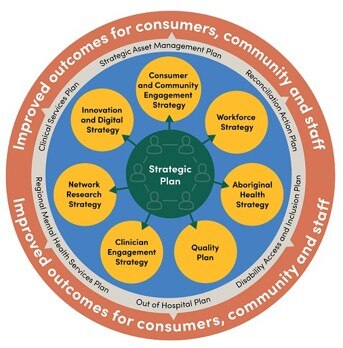
The diagram shows how the Strategic Plan is supported by seven enabling strategies and six delivery plans that work together to achieve improved outcomes for consumers, community and staff.
Enabling strategies
- Consumer and Community Engagement Strategy
- Workforce Strategy
- Aboriginal Health Strategy
- Quality Plan
- Clinician Engagement Strategy
- Network Research Strategy
- Innovation and Digital Strategy
Delivery plans
- Strategic Asset Management Plan
- Reconciliation Action Plan
- Disability Access and Inclusion Plan
- Out of Hospital Plan
- Regional Mental Health Services Plan
- Clinical Services Plan


